Experience Rating Plan

A core pricing mechanism that promotes fairness, accountability, and data-driven decision-making 

The Experience Rating Plan is a mandatory, actuarially sound methodology that adjusts workers’ compensation premiums based on an employer’s individual loss experience relative to similarly classified employers. By directly linking pricing to historical performance, the plan rewards effective safety and claims management while ensuring risks with higher-than-expected losses are priced appropriately. 

Abstract blue light streaks representing data and digital flow.

Supporting Systemwide Fairness & Stability

PCRB administers Pennsylvania’s Experience Rating Plan using approved formulas, validated data, and uniform standards. This ensures experience modifications are calculated consistently and transparently, providing members with confidence in the accuracy of premium adjustments and supporting a fair, equitable workers’ compensation system statewide.  

By maintaining a transparent and consistently applied Experience Rating Plan, PCRB helps ensure:

  • Premiums accurately reflect individual risk performance 
  • Employers are incentivized to invest in safety and loss control 
  • Carriers can price policies responsibly and consistently
  • Regulators can rely on objective, data-driven standards

This structured approach reinforces confidence in Pennsylvania’s workers’ compensation system and supports long-term market stability.  

Update Effective 4/1/2024

PCRB updated the Pennsylvania Experience Rating Plan effective April 1, 2024. These changes were intended to preserve actuarial integrity, enhance clarity, and ensure the plan continues to function as a reliable and equitable pricing tool for all qualifying risks. 

Members should review resources available on this page to understand what is changing, how the updates affect experience modifications, and what actions—if any—may be needed. 

Experience Modification Calculator

Estimate experience modification factors and compare results between the current and updated plans.


Experience Rating Plan Pamphlet

Plain-language overview of Experience Rating principles and the 2024 plan updates

Experience Rating Plan Fact Sheet

Plan comparisons, key terminology, and glossary supporting interpretation of the 2024 mod worksheet.

FAQs

The goal of the research was to enhance plan performance through improved predictive accuracy that incentivizes workplace safety.
The last major update to the current Experience Rating Plan (ERP) was in 2004. Research identified opportunities to improve the current plan and to improve the cohesiveness between the Merit Rating and Experience Rating plans.

No. While other formulas and approaches were analyzed, it was determined that the current formula could be sufficiently optimized to achieve the target performance metrics. Also, some of the formulas in other states were comparable to the PA formula as credibility levels approach 100%. The current formula is [Ap x C + E x C x L + E(1.000 – C)] / E, where Ap = Actual Primary Loss, E = Expected Loss, C = Credibility, and L = Limitation Charge.

  • Eligibility Requirement: The minimum premium requirement is being reduced to $5,000 from $10,000. The premium requirement is based on premium developed by the audited payrolls or other exposures of the experience period, extended at current PCRB Loss Costs. The premium requirement for Merit Rating will be for risks that generate less than $5,000 on the same basis as stated above.
  • Split Point/Loss Limit: The plan will have a variable Split Points based on Expected Loss amounts ranging from $10,000 to $300,000. This is different from the current plan, which used a single Split Point of $42,500 for all Expected Loss amounts.
  • Credibility Values: With the change to variable Split Points, credibility was increased generally for all sizes of risks ranging in value from 69% to 97%.
  • Capping Rules: A Maximum Modification formula will be used with a starting value of 1.10 and increase as a function of Expected Losses. In addition, any other larger single year increases will be limited in cases where the indicated modification or the Maximum Modification results in a change above +40% compared to the prior medication factor. In these situations, the final published modification factor will the resulting modification factor capped at 40% above the prior modification.

By introducing a Maximum Modification formula and reducing the eligibility level, this will result in a better transition for risks that move between the Merit and Experience Rating plans. It also limits debit modifications for the smaller more volatile risks with expected losses between $10,000 and $25,000 compared to the current plan. Also, the introduction of the variable split point improves stability and allows for the application of higher credibility values on the Actual Primary Losses (Ap) to improve performance across all risk sizes. Lastly, the new capping rules ensure a reasonable level of stability for year-to-year changes.

As with any new plan, this question is difficult to answer as there will be modifications that don’t change very much (between +/-10%), some that go up by more than 10%, and some that go down by more than -10%.

Statewide, more risks will see modification reductions compared to increases, however changes will be greater for both the best and worst performing risks (i.e. risks with debits will often see larger debits and risks with credits will see larger credits).

There is a Modification Calculator Tool published on our website that allows users to enter exposure and loss data and shows how their mod will change under the new plan.

The Maximum Modification formula will be used which increases with higher Expected Losses. If the indicated modification is higher than the Maximum Modification, then the final published modification will be the Maximum Modification. In addition, any other larger single year increases will be limited in cases where the indicated modification or the Maximum Modification results in a change above +40% compared to the prior medication factor. In these situations, the final published modification factor will the resulting modification factor capped at 40% above the prior modification.

For the risks that are currently Merit rated, risks getting a Merit mod of 0.95 will generally see a lower credit mod and for risks that are getting a 1.05 debit mod will generally see a larger debit, however they might be subject to the Maximum Modification. Due to the Maximum Modification formula, risks with Expected Losses of $25,000 or less will no longer have modifications above 2.10.

The minimum premium requirement is being reduced to $5,000 from $10,000. The premium requirement is based on premium developed by the audited payrolls or other exposures of the experience period, extended at current PCRB Loss Costs. The premium requirement for Merit Rating will be for risks that generate less than $5,000 on the same basis as stated above.

The new ERP was designed to perform better for both larger and smaller risks. The Merit rating plan is a very basic plan intended for only the smallest of risks. Testing on risks between $5,000 and $10,000 showed that the new ERP performed well. In addition to performance, a lower eligibility threshold in conjunction with the use of Maximum Modifications allows for a better transition between the Merit and Experience Rating plans for the smaller risks. Due to statutory limitation, the Merit rating plan could not be eliminated entirely. Even with the lower eligibility amount, 63% of the statewide risks would remain Merit rated.

Small risks that now meet the lower $5,000 ERP eligibility threshold will get an Experience rating factor instead of a Merit rating factor.

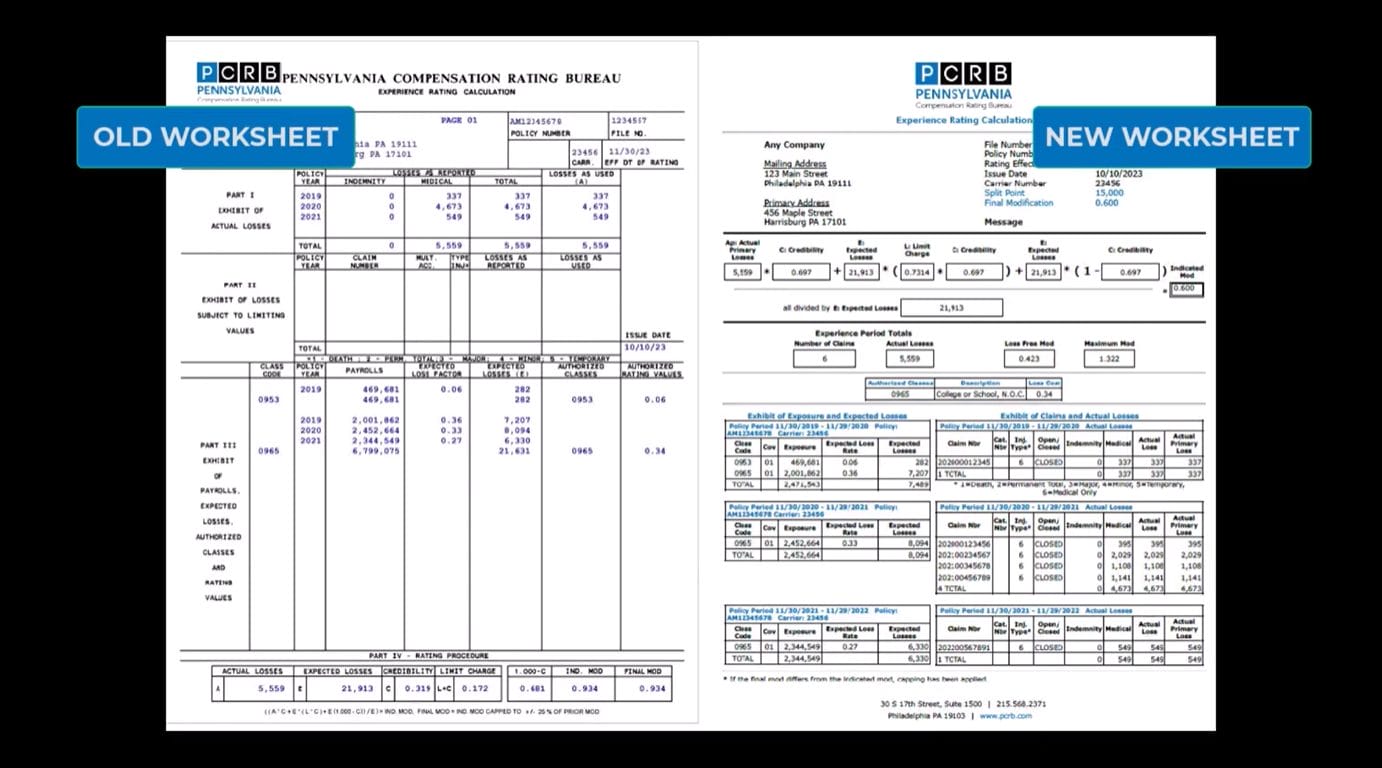
Yes, the modification worksheet has been refreshed and enhanced. Changes in format were made to make it easier to read and more consistent with some other states. New information was added such as a listing of all individual losses rather than only the losses that were above the spit point/loss limit and a modification “Status” to show if the modification has been revised.

A Glossary of Terms can be found within the Experience Rating Plan section of the PCRB website, www.pcrb.com, with definitions of all terminology found on the worksheet.

For a 2-year period, (April 1, 2024- March 31, 2026) the current capping rules would apply in addition to the use of the new Maximum Modification formula. The current capping rules utilize both +/-25% swing limits and a secondary capping rule (a rule that produces a mod of 1.0 in cases where the current mod is a debit mod, above 1.0, but the indicated mod is a credit mod below 1.00 and the -25% swing limit capped mod would still results in a mod above 1.0.

The 2-year transition period capping will no longer apply for mods effective April 1, 2026.

After the 2-year transition period, only the new capping rules apply (maximum modification and +40% swing) and the +/-25% swing limits and the secondary capping rule no longer applies.

Yes. When the new experience rating plan is filed with a target effective date of 4/1/2024, the corresponding loss costs filed for 4/1/2024 will be adjusted (“off balanced”) to make the ERP changes revenue neutral. For example, if the new ERP plan results in average experience modification factors that reduced premiums by 5%, then the average loss costs will need to increase by 5% to achieve no overall change in premium due to the implementation in the new plan. If it is assumed that the overall loss cost indication change was -6% in this example, then the final filed overall change to loss costs with the implementation of the new experience rating plan would be roughly -1% (-6% plus the 5% off-balance).

No. With the approval of PCRB Filing No. 323, ratable losses that enter the plan formula will be reduced by the subrogated amounts and then limited by the split point if applicable.